You Drew That?! How Anime-Inspired TikTok Tutorials Are Turning 'I Can't Draw' Into 'Wait, Actually I Can'
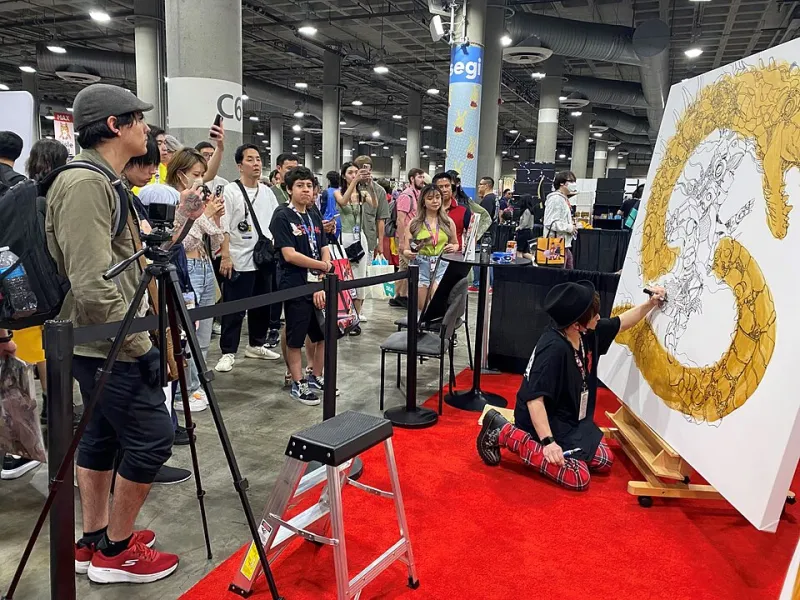
Photo: Yasumanta, CC0, via Wikimedia Commons
Let's establish something right up front: "I can't draw" is one of the most frequently told lies in America. Not malicious lies — more like inherited ones. Somewhere around third grade art class, a lot of people decided they weren't "art people," filed that belief away, and carried it into adulthood like a very boring piece of luggage. The art world, historically, did little to challenge this. Traditional instruction could be intimidating, expensive, and — let's be honest — sometimes a little gatekeep-y about what counted as "real" art.
Then anime happened. Or rather, then anime happened on TikTok, at scale, taught by a new generation of creators who looked directly into the camera and said: "You can do this. Start with the eyes. I'll show you."
The results have been, to use the technical term, completely unhinged in the best possible way.
The Algorithm Discovers Art Class
Scroll through TikTok's art side for more than ten minutes and a pattern emerges. Between the satisfying resin pours and the speed-painting videos, there's a thriving ecosystem of tutorial creators specifically teaching anime and manga-inspired techniques. And these aren't polished, intimidating demonstrations by artists who've been drawing since the womb. Many of them are people in their twenties who learned these skills relatively recently and decided to share the process in real time, imperfections and all.
The format is perfectly suited to the platform. Short, focused, repeatable. One video might cover nothing but how to draw expressive anime eyes — the specific curve of the upper lash line, the placement of the highlight dot, the way the iris catches light in that characteristic style. Another breaks down the construction of a Ghibli-style hand: slightly rounded, soft at the joints, with that unmistakable warmth that makes Studio Ghibli characters feel like you could actually hold their hand if you tried hard enough.
Viewers watch once. Then they watch again, this time with a sketchbook open. Then they post their attempt in the comments. Then they come back tomorrow for the next one.
It's a feedback loop that traditional art education almost never managed to create, and it's happening at a scale that would have seemed impossible even fifteen years ago.
Why Anime, Specifically?
This is the genuinely fascinating question, and the answer involves more than just pop culture popularity — though the popularity certainly helps. Demon Slayer, Jujutsu Kaisen, My Hero Academia, and the eternal gravitational pull of Studio Ghibli have kept anime firmly embedded in American mainstream consciousness. When people want to learn to draw something recognizable, something they love, anime characters are a natural starting point.
But there's a deeper structural reason, too. Anime and manga have a visual language that's remarkably learnable in parts. The stylization that makes anime characters distinctive — the large, expressive eyes, the simplified nose and mouth, the fluid hair that operates by its own physics — is actually built from repeatable, teachable shapes. Unlike photorealistic portraiture, which requires years of observational training, anime style rewards pattern recognition and deliberate practice with visible results relatively quickly.
That quick feedback loop is psychologically enormous. When a beginner draws their first recognizable anime eye and it actually looks like an anime eye, something shifts. The "I can't draw" story gets a crack in it.
Creators like the ones proliferating across TikTok and Instagram understand this intuitively. Many of them specifically structure their tutorials to deliver that early win — the moment where a complete beginner produces something that surprises them. From there, the hook is set.
Meet the Instructors Quietly Changing Things
The creators driving this moment are a varied bunch, which is part of what makes the phenomenon interesting. Some have formal art training and use anime techniques as an accessible entry point to broader skills. Others are entirely self-taught, which — crucially — they say out loud, repeatedly, because it matters to the audience.
Creators in this space frequently describe receiving the same comment: "I've always wanted to draw but thought I wasn't talented enough." The response from most of these instructors is consistent and almost evangelical: talent is not the variable. Practice is the variable. Anime style, with its learnable building blocks, is a particularly good environment for that practice because the feedback is immediate and the subject matter is genuinely motivating.
Several creators have noted something interesting about their American audience specifically: there's a particular relief that comes through when people realize that the style they're learning is taken seriously as an art form in Japan — that manga artists are celebrated professionals, that animation studios like Ghibli are considered cultural institutions. For Americans who grew up being told that cartoons and comics weren't "real" art, this recontextualization hits differently.
One recurring theme in comment sections is the intergenerational aspect. Parents drawing alongside kids. Adults in their forties picking up a sketchbook for the first time. The tutorials function as permission slips as much as they function as instruction.
The Democratization Nobody Announced
What's happening here is, without much fanfare, a genuine democratization of artistic skill-building. Traditional art education in America has always been unevenly distributed — robust in some schools, gutted in others, expensive in private contexts. The idea that quality instruction should be accessible only to those who could afford classes or lived near the right institutions has been quietly dismantled by a person with a ring light, a sketchbook, and a TikTok account.
The anime connection is key to why this particular wave landed the way it did. Japanese pop culture carries enormous cultural currency with the exact demographics most underserved by traditional art education. When the style being taught is something you've loved since you were twelve, the motivation to show up for the next tutorial is built-in.
There are critics, of course — there always are. Some in the fine art world have raised eyebrows at the stylization, the shortcuts, the emphasis on a single aesthetic tradition. But those critiques tend to miss the forest for the trees. The goal was never to produce the next generation of classical painters. The goal, for most of these creators and their audiences, is simply to make drawing feel possible.
And by that measure? The Ghibli hands and Demon Slayer eyes are doing something quietly significant. They're turning a lie that millions of Americans have told themselves for decades into a question worth revisiting.
Pick up a pencil. You might surprise yourself.