Customs Didn't Stop Them: The Obsessive Americans Packing Their Suitcases Full of Japanese Erasers
Let's set the scene. You've just landed at LAX after two weeks in Japan. The person in line ahead of you at baggage claim is sweating slightly. Their checked bag is, by their own estimate, about 60% erasers. Not drugs. Not jewelry. Erasers. Tiny, pastel-colored, architecturally perfect blocks of rubber that smell faintly of peach and make correcting a mistake feel like a spiritual event.
Welcome to the stationery underground. Population: more Americans than you'd think, and all of them completely unapologetic about it.
It Started Innocently Enough (It Always Does)
For most collectors, the gateway drug was a single Pentel Hi-Polymer or a Mono Zero eraser stumbled upon in a Japanese dollar store equivalent — the beloved hyaku-en shops like Daiso or Seria. These are not the sad pink rectangles that smear your homework into a gray fog of regret. These are precision instruments. They erase cleanly, completely, and somehow without destroying the paper beneath them. They come in shapes. They come in scents. Some of them are so cute you feel genuinely bad using them.
Once you've used a Japanese eraser, the standard American drugstore version starts to feel like wiping your mistakes with a potato.
So people go back. And they buy more. And then they start researching which erasers are only available in specific regions of Japan, and suddenly they've built a spreadsheet, and the spreadsheet has tabs, and one of the tabs is labeled "Priority Targets" and another is labeled "Do Not Open — Display Only."
This is a normal hobby now.
The Economics of Rubber and Regret
Here's where it gets genuinely fascinating from a market perspective: Japanese stationery, particularly erasers and correction tape from brands like Tombow, Seed, and Hinodewashi, is priced modestly in Japan — often between 100 and 500 yen per item. That's roughly a dollar to four dollars. In the United States, the same items — when you can even find them — routinely sell for two to five times that amount on Amazon, and considerably more on resale platforms like eBay, Mercari, and Depop.
Limited-edition seasonal releases, regional exclusives, and collaboration items (think Sanrio-branded correction tape or Ghibli-themed eraser sets) can flip for anywhere from $15 to $50 a pop, sometimes more if the item is sealed and the listing photos are good. A sealed set of Iwako puzzle erasers from a defunct collaboration can quietly command the kind of price that makes you do a double-take and then immediately check your own junk drawer.
Collectors who travel specifically to Japan for stationery hauls — and yes, these people absolutely exist — describe the trip economics with the calm confidence of someone who has done the math many times. "I budgeted about $300 just for stationery on my last trip," one collector from Portland told us over DMs, requesting we not use her full name because, quote, "my family already thinks I have a problem." "I came back with probably $900 worth of stuff at US resale prices. I didn't sell any of it, but still. The value is there."
The Hunt Is Half the Point
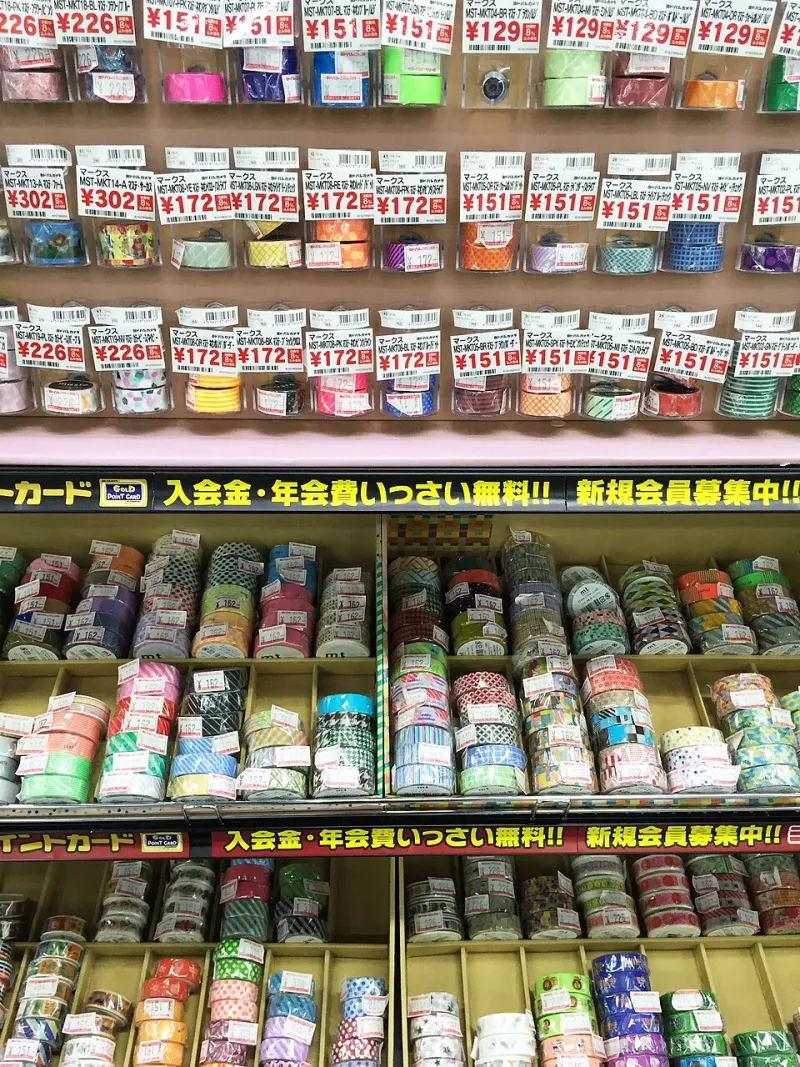
What separates stationery collecting from just... shopping... is the ritualized intensity of the search. Devoted collectors maintain lists, follow Japanese stationery Instagram accounts, and monitor the websites of stores like Itoya in Ginza or the stationery floors of Tokyu Hands and Loft with the focus of someone tracking a limited sneaker drop.
There are regional exclusives. There are seasonal colorways that disappear in March. There are collaborations announced only in Japanese that sell out before any English-language account can even post about them. The information asymmetry alone is enough to make the whole pursuit feel genuinely thrilling.
"I found a set of Hinodewashi 'Matomaru-kun' erasers in a colorway I had never seen documented anywhere online," said one collector from Austin, Texas, who runs a small stationery-focused Instagram account with a surprisingly devoted following. "I bought every single one they had in stock. I still don't know if it was a regional thing or a production error. That mystery is part of why I love it."
The mystery is, in fact, deeply part of why this whole subculture has legs. In an era when most consumer goods are a same-day Prime delivery away, Japanese stationery retains a genuine scarcity that feels almost retro. You cannot just get certain things unless you are physically present in Japan, or willing to pay a significant markup through a proxy shopping service, or lucky enough to know someone who's heading to Tokyo next month and owes you a favor.
The Resale Gray Zone
Not everyone in this community is buying purely for personal use, and the ethics of that get a little murky in the group chats. Some collectors buy multiples of limited items with every intention of reselling, which drives up in-store prices for locals and other tourists trying to grab a single pack. Sound familiar? It's the sneaker scalper playbook, applied to correction tape.
The stationery community, for its part, has complicated feelings about this. "I get it, but I also kind of hate it," said one collector who asked to be identified only as "Washi Tape Wendy," which, honestly, is a great name. "When I show up to a Loft and there are three packs left of something because someone already cleaned the shelf, that's frustrating. But also I've definitely bought extras of things I knew would be hard to find in the US. So."
So indeed.
Why These Things, Though?
The deeper question — the one that stationery outsiders always ask — is why erasers. Why not something more obviously glamorous?
The answer, when you push collectors on it, tends to circle back to the same few themes: craft, care, and the particular pleasure of objects that do exactly what they're supposed to do, beautifully. Japanese stationery culture prizes function as much as form. An eraser that erases perfectly is not a trivial achievement. A correction tape dispenser engineered to tear cleanly every single time is a small mechanical miracle. These are humble objects treated with the same design seriousness that other industries reserve for luxury goods.
In a world full of products that disappoint, there's something quietly radical about a thing that just works, looks good doing it, and fits in your carry-on.
Also, they're extremely cute. That part matters too.
The Luggage Always Tells the Truth
If you want to spot a stationery collector returning from Japan, look for the person at baggage claim who is very carefully lifting their suitcase off the belt. Not because it's heavy — though it might be — but because somewhere inside, wrapped in a shirt and nestled between rolled-up socks, is a limited-edition eraser set they are not willing to explain to anyone who isn't already in the know.
Customs forms have a line for goods purchased abroad. Most stationery collectors fill it out honestly, list the value, and pay whatever small duty applies without complaint. The real cost, they'll tell you, is the three extra hours you spend in Itoya when you were supposed to be at a museum.
No regrets, though. Never any regrets.